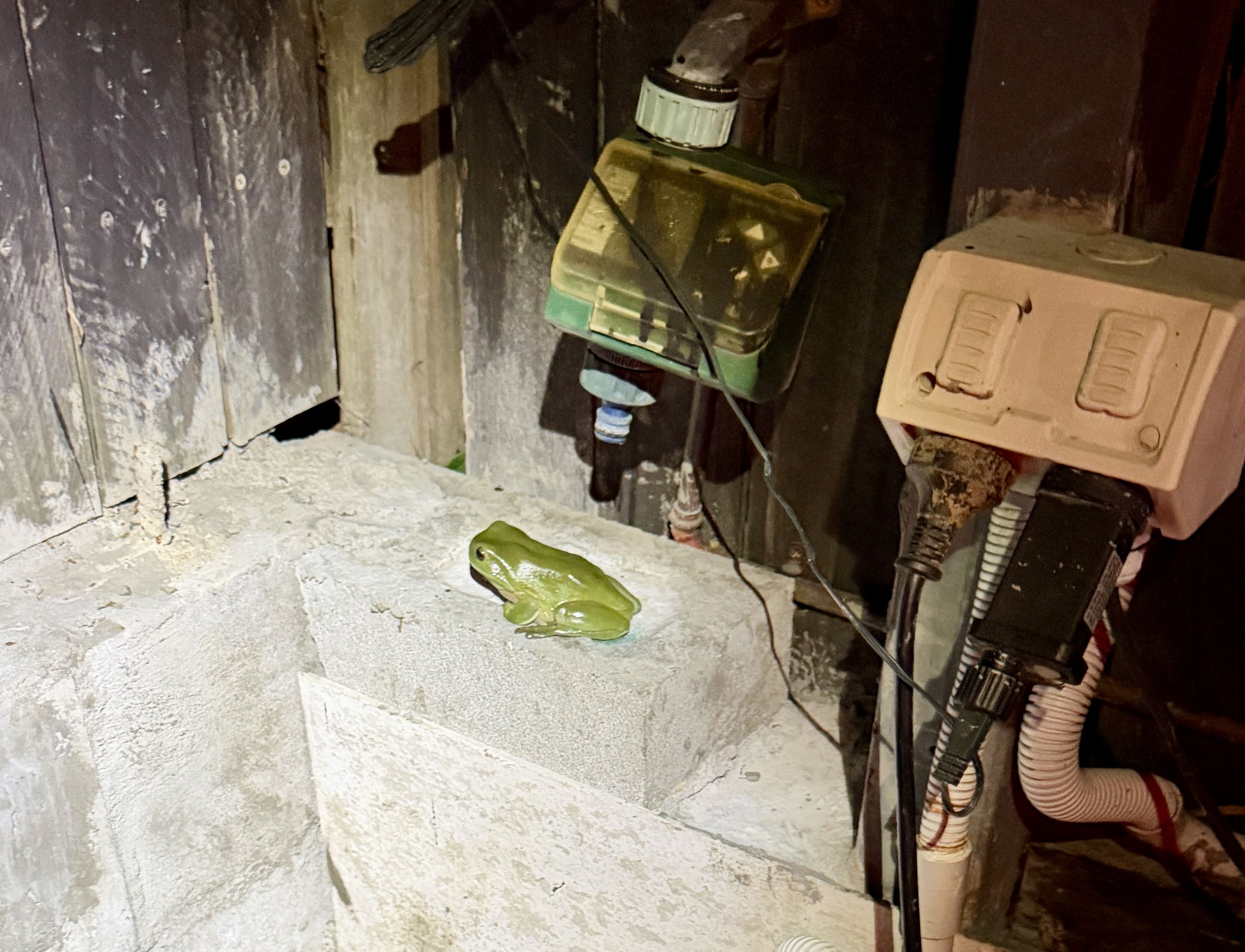
Getting this identification right matters — and not just for environmental reasons. Misidentifying a native frog as a cane toad and removing it is illegal under Queensland law. Misidentifying a cane toad as a native frog and leaving it in your yard puts your pets at risk.
This guide gives you the information to make a confident call in the field, at night, under pressure — covering adults, juveniles, tadpoles, and the native species most likely to cause confusion.
The Five Key Identifiers for Adult Cane Toads
When you find an adult animal and need to identify it quickly, work through these five features in order.
1. The parotoid glands
This is the single most reliable identifier and the one to check first.
Cane toads have a pair of large, raised, kidney-shaped glands behind each eye, extending toward the shoulders. They are clearly visible as a prominent ridge or hump sitting just behind and below the eye. This is where the toxin is produced.
No Queensland native frog has this structure. If you can see it clearly, you are looking at a cane toad.
2. Skin texture
Cane toad skin is dry, rough, and covered in prominent warts and bumps. It has a distinctly rough appearance even from a short distance.
Native frog skin is smooth or finely textured and looks moist. Even native species with some surface texture will appear noticeably smoother than a cane toad of comparable size.
3. Body posture and shape
Cane toads sit upright and rounded. They hold the body raised, with a hunched, heavy appearance from the side. Their hind legs are relatively short compared to body size.
Most native frogs sit lower to the ground with a flatter profile and legs angled outward. Frogs adapted for jumping tend to look longer and leaner relative to their body.
4. Movement
Cane toads walk or shuffle. Their movement is slow and deliberate. When startled, they make short hops but lack the explosive, long-distance jumping of most native frog species.
Native frogs are generally faster and springier. A frog that takes a long, rapid series of hops is almost certainly a native species.
5. Colour
Do not rely on colour for identification. Cane toads range from grey-brown to yellow-brown to olive. Native frogs span an even wider range. Colour varies with environment, temperature, stress, and individual variation. It is the least reliable field identifier available.
Juvenile Cane Toads — The Hardest Identification
Juvenile cane toads are the most common source of misidentification. Freshly emerged toadlets can be as small as 1cm — similar in size to many native frog juveniles.
At this size, the parotoid glands are less pronounced, the warts are less developed, and size cannot be used to distinguish species. Despite this, juveniles still have identifiable features:
Early parotoid development: Even small juvenile cane toads often show a slight ridge behind the eye. It may be subtle, but it is usually present.
Skin texture: Juvenile cane toads are still dryer and rougher than native frog juveniles of comparable size.
Movement: Juvenile cane toads shuffle and make very short hops. Native frog juveniles, even at small sizes, tend to spring more readily.
Mass emergence: Cane toad breeding events produce toadlets in large numbers simultaneously. If you find dozens of identical very small toadlets emerging from water's edge, they are almost certainly cane toads. Native frog emergences are generally smaller scale and less uniform.
When dealing with juveniles, if you cannot make a confident identification, do not remove them. Photograph and seek assistance.
Tadpole Identification
Cane toad tadpoles can be present in any still or slow-moving water body — ponds, garden dams, roadside puddles, and irrigation infrastructure — and can be found in large numbers during breeding season.
Cane toad tadpoles:
- Uniformly black or very dark brown when viewed from above
- Small, typically 1 to 2.5cm throughout most of development
- Move in dense, tightly packed schools near the water surface
- When disturbed, the school swirls and disperses rapidly
- Often found in very shallow margins
Native frog tadpoles by comparison:
- More variable in colour — often brownish, tan, or with visible lighter areas
- Generally larger than cane toad tadpoles at equivalent development stages
- Less likely to be found in dense surface schools; more varied in position in the water column
- Often found feeding along the bottom
For garden ponds and small dams, if you see a large mass of uniform black tadpoles in the shallows, this is a strong indicator of cane toad breeding. The sheer density and uniformity of the school is characteristic.
Native Species Most Often Confused With Cane Toads
Striped marsh frog (Limnodynastes peronii)
One of the most abundant frogs in South East Queensland. Medium-sized, stocky, and brown-patterned. At night and at a glance, it can look similar to a small cane toad. Close inspection reveals smoother skin, no parotoid glands, and a more streamlined body.
Giant barred frog (Mixophyes fasciolatus)
Found near rainforest waterways. Large size and robust build can cause confusion with adult cane toads. Smooth skin and the absence of parotoid glands confirm native frog status.
Broad-palmed rocketfrog (Litoria latopalmata)
A medium-sized, dry-adapted species with slightly textured skin. The texture sometimes causes concern, but it is noticeably smoother than a cane toad and no parotoid glands are present.
Eastern banjo frog (Limnodynastes dumerilii)
Also known as the pobblebonk. Stocky and burrowing, sometimes found on the surface after rain. Brown colouring and rounded body shape can resemble a cane toad. Check the parotoid glands — banjo frogs do not have them.
What to Do When You Are Not Sure
Do not handle the animal without thick rubber gloves. Even if it turns out to be a native frog, gloves protect you.
Photograph it clearly from above and from the side. Capture the area behind the eyes, the skin texture, and the overall body shape if possible.
Use identification resources:
- The Queensland Government's FrogID app allows photo-based frog identification
- Watergum's community identification resources and volunteer network can assist with uncertain cases
- FrogWatch Queensland maintains extensive resources for frog identification
If in doubt, leave it. A cane toad left in place for an extra day while you confirm identification causes less harm than a misidentified native frog removed and disposed of.
Once You Have Confirmed a Cane Toad
Wear thick rubber gloves. Place the toad in a sealed container or bag and put it in the freezer for 24 hours. This is the currently accepted humane euthanasia method endorsed by the RSPCA.
Do not use OraGel, benzocaine, or other chemical euthanasia products unless you are trained in their use. Improper application can cause prolonged suffering.
Do not release captured toads into other areas, including waterways or neighbouring properties.
For help managing cane toads on your property — or if you want a professional to assess what is in your yard — contact us. We also partner with Watergum to ensure only cane toads are ever removed, never native wildlife.